
If you’re a practitioner, coach, or wellness founder, selling supplements on your own website sounds like the obvious next step. Your clients already ask what you recommend. You already trust certain products. A store feels like a way to serve people better and add a revenue stream that doesn’t depend on your calendar.
It can be all of that. But supplements are one of the trickiest things to sell online, and most of the stores that stall don’t fail because of design. They fail because of a decision nobody made before launch.
Why Supplements Aren’t Like Selling Anything Else
A course or a coaching package is simple to sell online. You deliver it, nothing ships, and nothing sits on a shelf. Supplements add three things that change the whole picture.
First, payment processors look at supplement businesses more closely than most. Health claims, recurring billing, and refund rates all put you in a category they watch. Second, the products themselves are regulated. What you’re allowed to say on a product page is narrower than most people expect. Third, physical inventory ties up cash. Every bottle on your shelf is money you’ve spent and haven’t gotten back yet.
None of this means you shouldn’t do it. It means the order of your decisions matters. Here’s the first one.
The 7 Questions to Answer Before You Launch
1. What Are You Actually Selling, and Who Carries the Risk?
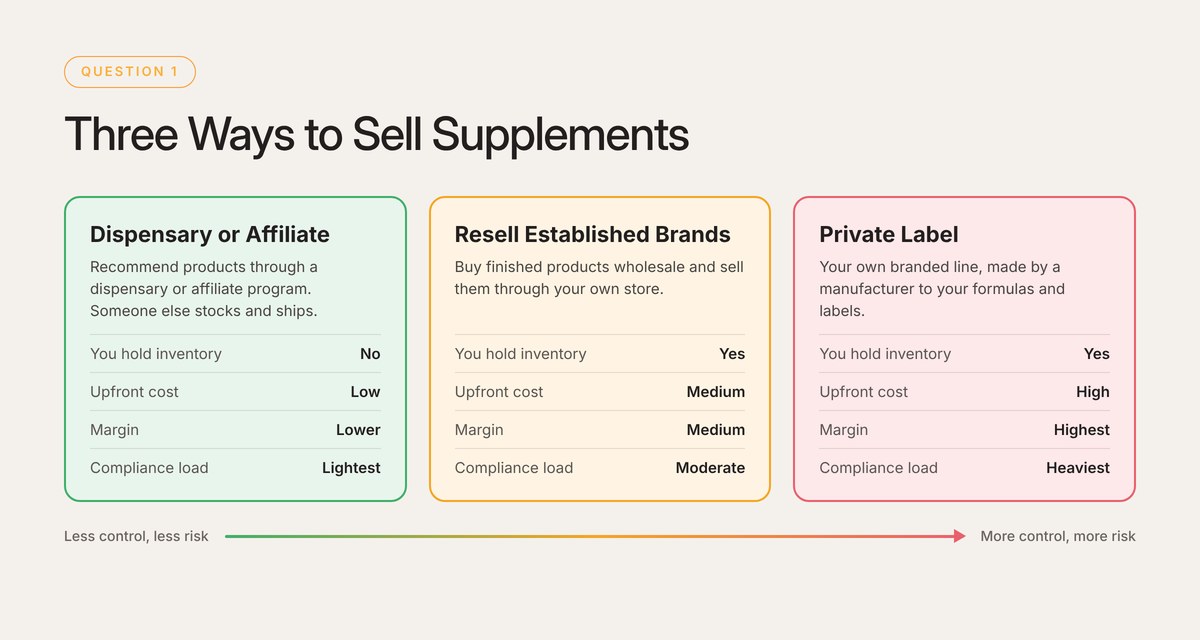
There are three basic ways to sell supplements. You can recommend products through a practitioner dispensary or affiliate program, where someone else holds the inventory and ships the order. You can buy finished products from established brands and resell them. Or you can create your own private label line.
Each step up gives you more control and more margin, and each step up moves more of the risk onto you: inventory, labeling, compliance, and customer service. Plenty of practitioners jump straight to private label because it feels like “real” branding. Starting with a dispensary first lets you prove people will actually buy before you spend thousands on a minimum order.
2. Will a Payment Processor Approve You?
This is the question most people never ask until it’s too late. A processor can approve your account on day one and freeze your payouts on day sixty after a closer review. When that happens, you’re not just losing sales. You may be waiting weeks or months to get money you’ve already earned.
Processors look at what your product pages claim, whether your policies are complete and easy to find, and whether you look like a real, reachable business. If your store is built around “cures,” “treats,” or “prevents” language, you’re starting with a problem. Plan your processor before you build, and know what you’d do if your first choice says no.
A store that can’t reliably accept payments isn’t a store. It’s a very expensive brochure.
3. What Will Each Order Really Cost You?
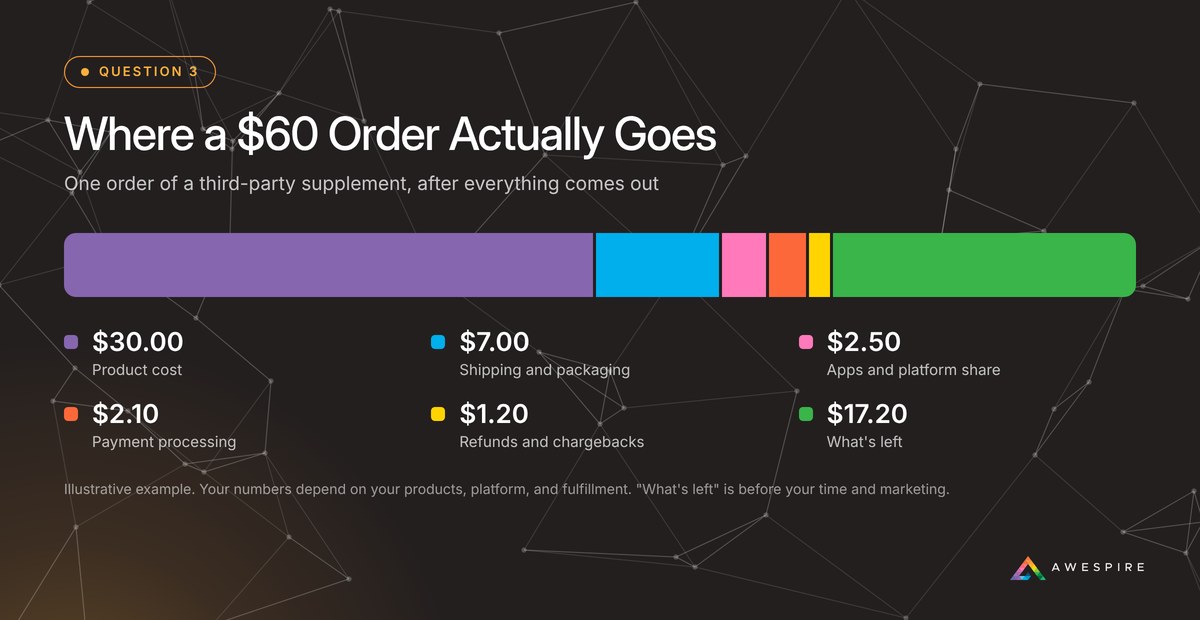
Most people compare platforms by the monthly fee. That number is the smallest part of the picture. A better question is what’s left from a typical order after the product, payment processing, shipping, packaging, apps, and the occasional refund.
Run that math on a real order before you choose Shopify or WooCommerce, and before you add a single paid app. If the margin only works at a sales volume you haven’t reached yet, you’ll want to know that now, not six months in.
4. Who Ships It, and What Happens When You Run Out?
You can pack orders yourself, have the manufacturer ship them, or hire a fulfillment company. Packing them yourself is cheapest on paper and most expensive in time. It also breaks the first week you’re sick or on vacation.
Subscriptions make this more important, not less. A subscription renews whether you have stock or not. Know who’s watching inventory, when you reorder, and what customers hear when something is backordered.
5. Do You Owe Sales Tax, and Where?
Sales tax on physical products depends on where your customers live, not just where you are. Many states now require you to collect once your sales into that state cross a set threshold, commonly around $100,000 in a year. Services, physical products, and digital products are often taxed differently, too.
Your store can calculate tax, but it can’t tell you where you’re registered or file anything for you. Talk to your accountant before launch, not after your first big month. (This isn’t tax advice, just a strong nudge to get some.)
6. Can a Stranger Trust Your Store in 10 Seconds?
Your current clients already trust you. A new visitor from Google doesn’t. They’re looking for quick signals: real product photos including the Supplement Facts label, clear shipping and return policies, a way to reach an actual person, and product copy that explains without overpromising.
Those same signals are what processors and ad platforms look for. Getting them right once helps you everywhere.
7. Who Runs It Every Week?
Launch is the easy part. After that, someone answers customer emails, handles a damaged shipment, updates the site, reconciles the books, and notices when checkout breaks at 9 p.m. on a Friday. In a small practice, that someone is usually you, on top of seeing clients.
Write down every recurring task and put a name next to it. If the same name shows up on every line, that’s your answer about whether you’re ready.
5 Signs You’re Not Ready to Launch Yet
- You’ve ordered inventory but haven’t picked a processor. Lock down how you’ll get paid before you spend on product.
- Your product pages promise results. If the copy says a product treats or cures something, it needs a rewrite before launch.
- You don’t know your margin on a single order. If you can’t say what you keep from a typical sale, you can’t price, discount, or advertise with confidence.
- Your policies are copied from another store. Shipping, returns, and privacy pages need to match how your business actually works.
- Nobody owns the store after launch. If “we’ll figure it out” is the plan for support and inventory, figure it out first.
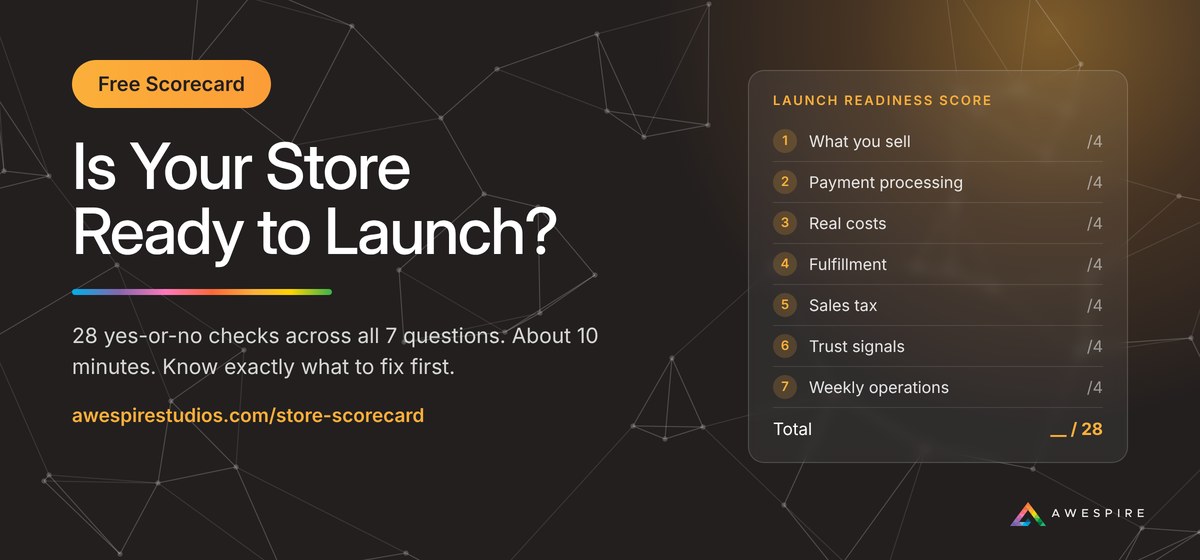
Not sure where you stand? We put together a free scorecard that walks through all seven questions in about 10 minutes and shows you exactly where the gaps are.
I’ve spent more than 22 years building websites and online stores, and a large share of that work has been for supplement brands and health practitioners. The pattern I see most often isn’t a bad website. It’s a store that launched before the business behind it was ready, then spent its first year fixing payment, tax, and fulfillment problems instead of selling.
The good news is that every one of those problems is cheaper to solve before launch than after. If you’re planning a store, or you have one that isn’t performing the way you hoped, we’ll look at where you stand and tell you plainly what to fix first.